Eight of the villages located near the national park on the south bank have over the years, through employment opportunities, conservation education programmes, community projects and through simply being good neighbours, built up a strong relationship with Stella’s various projects.
The concept of the SSS came about when Stella met a bright and determined 10 year old boy who lived in Sambel Kunda about 2.5 km from the chimp camp and one of the eight nearby villages. His mother was even poorer than the average villager as she has no husband; she could not afford to send him to school. He spent his days herding cattle for other people. But he wanted to go to school and his answer to this problem was to find good grazing near the school and while his cattle fed he could run and try to attend some classes. When his herd took him nearer the chimpanzee camp he would stop and talk to the staff. He did his best to be useful around camp and borrowed any reading material he could find. At every opportunity he would tell the staff how much he wanted to go to school on a regular basis but his mother could not afford this. As a result of this youngster’s persistence Stella began to take a new interest in the Sambel Kunda village government primary school. She discovered that it cost very little to send a child to primary school for a year. The boy’s thirst for knowledge had made a big impression on Stella and she undertook to personally sponsor his education. She mentioned this to visitors to camp and to friends back in UK and they said they would like to help: and so the idea for the SSS took root and started to grow.
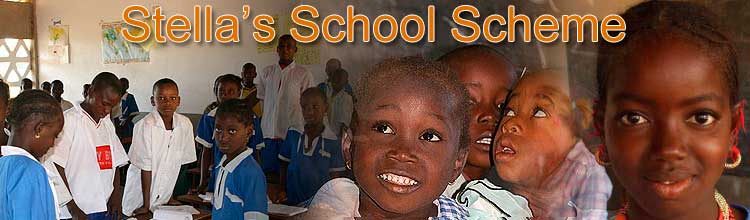
There are several hundred youngsters in the neighbouring the villages who are eager to learn. Many come from families that lack the resources to send all their children to school. Being sponsored and so able to attend school could make the difference between becoming a subsistence farmer - or one of his wives - or becoming an engineer or doctor or president, etc. The SSS was established to generate funds and help educate the children from these villages in order to improve the chances of changing the path of their lives might take.When Stella’s idea of the SSS germinated the village school, with two teachers and only 90 children, was under the threat of closure. Now thanks to so many people – not only all our sponsors and donors but many others: in particular Master Darboe (the head master), Boubacar Barry (SSS book keeper & imam of Sambel Kunda), Mr Sawareh (Regional Director of Education) and Rosie Peattie in UK (SSS volunteer administrator UK until July 2009) – there is a team of 14 teachers & the school roll exceeds 400.
Master Darboe is still there as the head of school. SSS pays the salaries of two nursery teachers (we plan to increase this to three) and pays a monthly inducement allowance to all the teachers in this relatively remote off-road school. Thanks to Stella’s drive and vision the school now has four new classrooms, an office for the headmaster, a storeroom and a new kitchen. All these were built by a Swedish NGO – Future in Our Hands – but only after Stella’s patient lobbying. There is now a two room nursery school unit, soon to become 3 rooms. It is made of mud blocks and initially had a thatched roof, now replaced with corrugate, but it is serviceable. The school has – amazingly – a small library funded, built and stocked initially by the Glasgow University Gambia Expedition of 2005. Equally amazing, or perhaps even more so, there is solar power for lighting a classroom, powering a laptop and recharging mobile phone batteries; and, when the Airspan system allows, there is an internet connection. All this thanks to the Electronics Department of Strathclyde University after a contact made through Stella and the chimpanzee connection.
The CRT’s operating arm, the CRA, was recently ousted (see CRT website) from managing and continuing the development of the chimp project and so prevented from establishing more community facilities. However there was no reason why these problems should jeopardise the future for the chimps and the nearby villagers. Stella knew that protecting the islands would be an ongoing task with no foreseeable end; and similarly that the chimps would need to be protected for as long as humans posed a threat to them. It was an integral part of Stella’s holistic approach to conservation to understand that if the children of the surrounding villages had the chance of an improved education then some might well go on to be people of influence in The Gambia. Such people might take with them some of CRT's values for conservation and wildlife protection and a measure of goodwill towards the CRT and the chimps. Education is also a very vital element in the development of this very poor rural area. Through SSS we hope to go some way towards breaking the cycle of poverty. In doing so we expect to provide the chimps with improved chances for their future by trying to ensure the concern and protection of the local community. If with your help we realise these hopes and expectations, then together we really will have achieved something very worth while. Please help us to do this by sponsoring a child today. It could be the most rewarding and effective use of a few pounds that you ever make. If you are unable to commit to a long-term sponsorship please just make a donation.